
Clutural Adventures Rio Blanco County
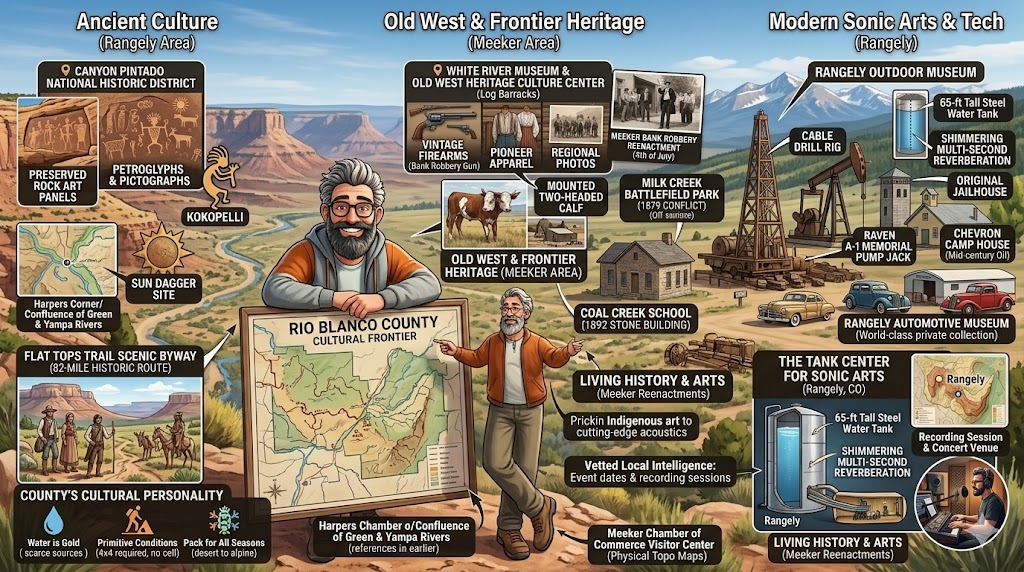
While Rio Blanco County is renowned for its wild backcountry landscapes, its deep-rooted cultural opportunities are equally compelling. The county’s cultural personality is built on a rich timeline that transitions from ancient Indigenous art to pioneering Old West conflicts, 1940s oil boom towns, and cutting-edge acoustic architecture.
Prehistoric & Ancient Culture
Long before homesteaders arrived, ancient civilizations left an indelible mark on the high-desert landscapes of western Rio Blanco County.
Canyon Pintado National Historic District
Located just south of Rangely along Highway 139, Canyon Pintado (“Painted Canyon”) is one of the most significant archaeological regions in Colorado.
The Heritage: The valley features hundreds of archaeological sites primarily tied to the Fremont Culture ($\approx$ AD 0–1300) and later Ute tribes.
The Experience: Hikers can easily access remarkably preserved rock art panels, petroglyphs (carvings), and pictographs (paintings) including the famous Kokopelli and Sun Dagger sites.
Old West & Frontier Heritage
The eastern gateway town of Meeker preserves a distinct, unfiltered brand of western frontier history, serving as the setting for some of the state’s most pivotal early American conflicts.
1. The White River Museum & Old West Heritage Culture Center
Housed in authentic 1880 log barracks originally built as living quarters for U.S. Army officers, the White River Museum in Meeker brings frontier life to reality.
The Artifacts: The curio museum features vintage firearms—including those used in the historic 1896 Bank of Meeker robbery—pioneer apparel, regional photographs, and even local oddities like a mounted two-headed calf.
Expansion: The nearby Old West Heritage Culture Center expands on this preservation work by hosting living history exhibits, historical presentations, and research archives.
2. Off-Site Historic Landmarks
Milk Creek Battlefield Park: Located 30 minutes from Meeker, this monument marks the 1879 conflict between the White River Ute Nation and the U.S. Cavalry, widely recognized as the last major Indian uprising in Colorado.
Coal Creek School: Built in 1892, this beautifully restored, award-winning stone building is the oldest rural school structure in the region.
Industrial Boom & Tech History
The town of Rangely offers a cultural deep dive into the industrial marvels that shaped the modern development of northwest Colorado.
1. Rangely Outdoor Museum
This sprawling museum complex captures the dynamic shift from prehistoric eras to early ranching life and the 1940s industrial oil boom that completely transformed the region.
Outdoor Artifacts: Visitors can explore massive relics, including a historic cable drill rig, the Raven A-1 Memorial Pump Jack, and Rangely’s original jailhouse.
Historic Structures: Wander through a preserved 1913 schoolhouse and a real Chevron Camp House documenting mid-century oil-field culture.
2. Rangely Automotive Museum
A massive hidden gem for mechanical enthusiasts, this boutique museum showcases a world-class, private collection of rare, pristine motor vehicles and motorcycles dating back to the early 1900s.
Modern Sonic Arts & Local Traditions
Rio Blanco County successfully blends its historic preservation with highly unconventional modern art forms.
The TANK Center for Sonic Arts (Rangely, CO)
One of the most unique acoustic destinations on Earth, The TANK is a 65-foot-tall, empty steel water tank from the steam-engine era that was discovered by musicians to have a profound, shimmering multi-second reverberation.
The Venue: It has been converted into an international destination and state-of-the-art concert hall where sound artists, musicians, and visitors from around the globe come to record and experience its otherworldly acoustics.
Living History & Living Arts
The community regularly honors its past with long-standing events, including the Meeker Bank Robbery Reenactment during 4th of July celebrations, where local actors recreate the 1896 shootout in the middle of downtown streets.
Visitor Insight: Much of the county’s heritage is preserved via the Flat Tops Trail Scenic and Historic Byway. Driving the 82-mile route across the mountains allows you to retrace the exact trails utilized by Indigenous peoples and early settlers for hundreds of years.